
Saturday, April 20, 2013
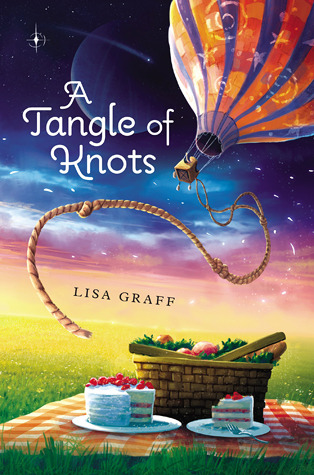
A Tangle Of Knots!
Hey everyone! Sorry for the delay, but I have been crazy buisness with school and work! I finished this book quite a bit ago, and I have to say . . . I love it! It's a very nice fluffy tale about a group of people that are connected in some way. There talents bring them together.
A girl who can make a person's perfect cake, just by looking at them, a guy who always goes missing, but always appears out of no where. Or a lady that can tell if a kid belongs to a certain family. You will love this book.

Thursday, April 18, 2013
A review of "Black Helicopters" by Blythe Woolston

The use of in media res and non-linear storytelling was definitely original, and made for a more interesting reading experience. The author does a good job of making you sympathize with a person who is obviously amoral and possibly insane, and doesn't belittle or disparage conspiracy theorists no matter how easy it would be to do so. Quite thought provoking.
Grade: B
A review of "Maggot Moon" by Sally Gardner

The dystopia itself is made up of jumbled bits of other settings: the run-down, veddy British state of V for Vendetta, the Stalinist purges of 1984, and the Nazi run government of the aforementioned Man in the High Castle, but this isn't really the point of the story. It instead seeks to tell a simple story of the resilience of the human spirit in times of trouble, and on that level, it succeeds. The writing is darkly humorous, and also Dashiell Hammett-level laconic, and the chapters are concise, so there's no real padding. I wish the author did more with her setting, but that probably would have just served to slow it down. The unnecessarily graphic/gross illustrations might not have been needed, though, just saying. Over all, worth checking out.
Grade: B+
Friday, April 12, 2013
Love and Other Perishable Items By Laura Buzo.

What attracted me at first was the cover and the title. I judged a book by its cover, but don't we all? I have been feeling like appreciating heart-broken teenage novels. But I do not like the ones with whiny girls that hunt down the most d-bag guy they could find. But according to the back reviews I have jumped ahead of myself. They critique the novel as,
"Smart, honest, and full of achingly real characters. And it made me laugh. What else would you want in a book?" -Melina Marchetta
It seemed like I would not be disappointed in the book based on the reviews. But the summary of the book was terrible. Amelia is a fifteen awkward teenage girl that loves to read books and mature her mind. This doesn't change the way she feels about Chris. Now what could be so bad about Chris? HE'S TWENTY-ONE YEARS OLD. He works with her at her job.
The book switches off between Amelia and Chris, but you mostly read about Amelia. And another important thing to know that I only fully noticed in the half of the book is that this is set in Australia.
Amelia immediately as soon as the book starts, falls in love with him. He affectionately calls her, "Youngster" as if she doesn't realize how much he doesn't see her as an equal. Of course, there are cute point of views between he and Chris from Amelia's view that I could relate to, being fifteen years old myself. But it doesn't excuse how ignorant she is about her relationship limit between her and Chris is. Even if she does "read" classics, that I haven't read I feel like I'm more mature than her. This interfered with the way that I read this book because I felt like I was reading about a super smart thirteen year old fall in love with her older brother.
The one thing I did like about this book is that the author actually gave Amelia a chance with Chris. She didn't look down on Amelia, making her look absolutely pathetic (even though she was at times)
Laura Buzo spins a new kind of relationship that actually makes Amelia and Chris' relationship work at times. I loved that part. But the part about making me laugh was not true, there is not one funny part in this book. None at all. The book is basically about their woes of life and how they're not brave enough to do anything about it. All they do is mope around the "Land of Dreams" (the store that they work at) and talk to each other about it. Amelia woes are with her family life, and Chris' is about a trashed love.
If you want to forget about your own troubles and feel like a young awkward teenager again, read this book. It has its good point and its bad. But its not a bad books overall, no matter how much this book conflicts with my values in life.
*Warning* For a fifteen year old girl, she goes to a lot of College Keggers where some bad stuff goes down sometimes. For example, a lot of alcohol drinking which is the leading problem for a lot of the bad examples this book sets. Just a warning you youngsters.
Thursday, March 21, 2013
Monday, February 25, 2013
Why I Couldn't Finish "Leviathan"

It promised a ripping yarn full of everything I mentioned previously, and it did, to an extent. What it didn't follow through on, though, was making the story interesting enough to survive without all the other trappings. The real test of a steampunk novel is if when you strip away the fantastical veneer, it still tells an interesting story, with compelling characters and a believable, but not too real setting. When you take the veneer off Leviathan, it leaves a sort of formulaic plot, and run of the mill characters. The protagonists are Deryn Sharp, a typical sort of Eowyn-esque "I wanna be a soldier but I'm a girl" character (her plotline actually has scenes that seem directly lifted from Disney's Mulan), and Aleksandar Hapsburg, who's a pretty boring "spoiled prince get's taught about the real world" type, and is also a bit of a jerk, considering that he murdered a guy in cold blood, but his character development consists mainly of him angsting over his inability to pilot a steam powered robot correctly.
Their stories would be interesting, if they went anywhere. There's no real build up of dramatic tension: Aleksandar, even though he's supposed to be running from people who want to kill him, spends a lot of time sitting around thinking, and Deryn doesn't face any conflicts in her quest to become a soldier, besides her gender, but as before, Westerfeld doesn't build up dramatic tension well enough to make me care about that conflict, or anything else in the story besides the mildly interesting technology system. Which brings me to another point: even if a certain work has a slightly predictable plot, if there are enough interesting ideas being winged your way, it doesn't matter as much. Look at Star Wars. Even though the plot is simplistic and the characters are archetypal to the point of cliche, there are so many "hey look at that, that's awesome" things happening to distract you from it.
In Leviathan, even though the genetically engineered animals and steam powered mechas are cool to look at (one good thing about this book is Keith Thompson's excellent illustrations), and the slang is just the right amount of incomprehensible and annoying to fully remind you you're reading an SF novel, there's a point at which one neat device or technology system isn't going to be as stunningly awe inspiring as it was the first time you saw it. Therein lies the issue: Leviathan doesn't have enough crazy concepts to change a dull SF novel, into a pulpy guilty pleasure, something Westerfeld's previous book Uglies did so well. And this would be fine, if the plot were interesting enough to exist on its own. As I said before, it isn't.
I know there are devoted fans of this book out there, and I fully respect their opinion on this, but for me, I thought the story and characters were dull, and there wasn't enough insane, off the wall things to keep me distracted from those shortcomings. I won't even get into the unfortunate implications of having genetically engineered animals fighting mechas in World War I. That's a review for a different day. And that's why I quit halfway through.
Subscribe to:
Posts (Atom)